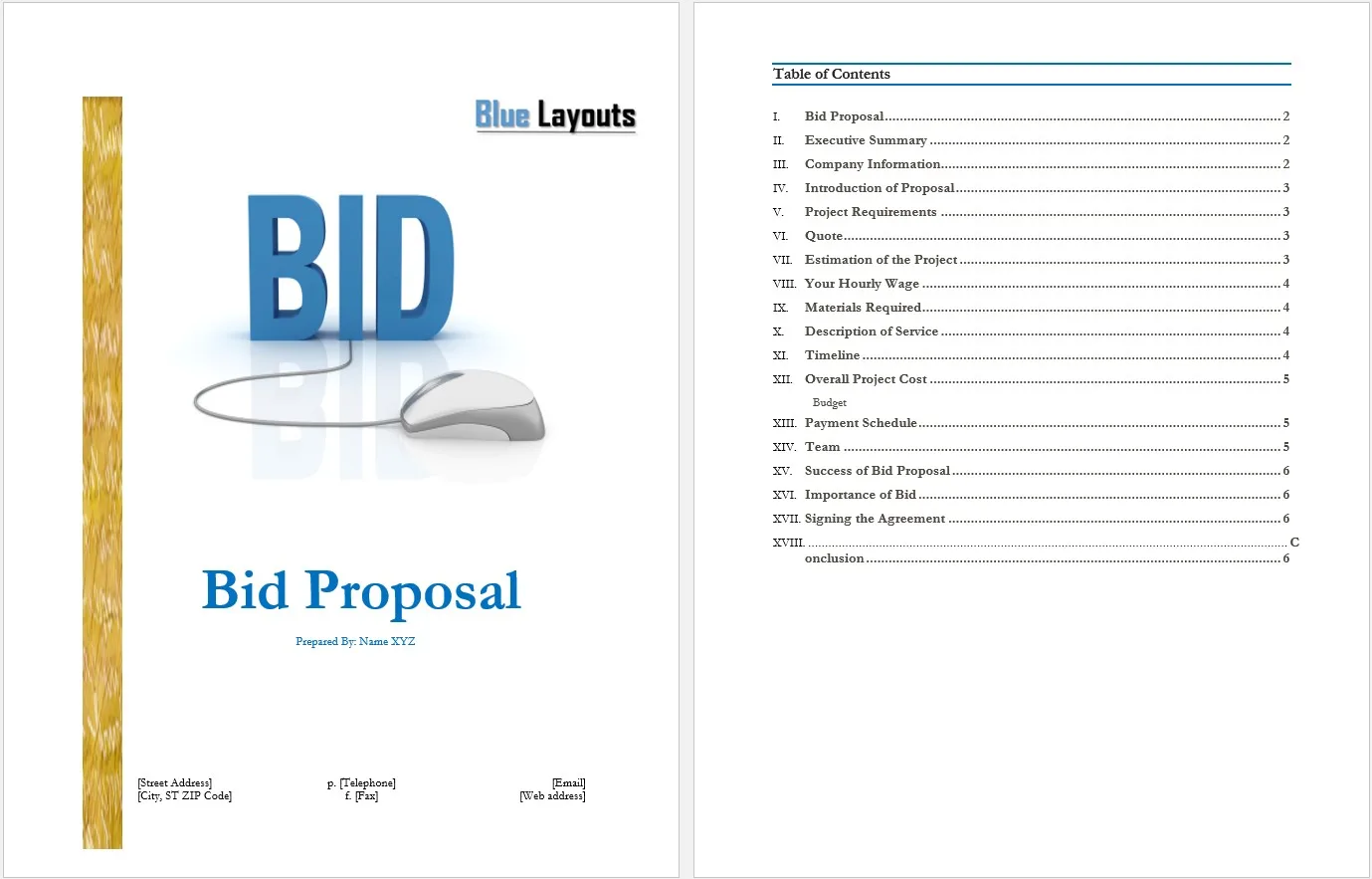
Build a structured offer for a defined project with this free bid proposal template for Word. Use its headings to organize your company details, proposed work, resources, pricing, schedule, and team.
The download is a narrative outline with explanatory sample text, not a ready-to-complete pricing form. Replace the guidance with your own proposal, add the tables you need, and follow the buyer’s actual submission requirements.
Format: Microsoft Word (.docx), supplied in a ZIP archive.
Included: A cover, contents list, and proposal headings covering the project, estimates, materials, services, timeline, overall cost, budget, payment schedule, and team.
Preview of the bid proposal document. Select the image to view it at full size.
Extract the ZIP archive and save a working copy before editing. No separate Excel cost calculator or PDF version is included.
Editing note: The file mixes construction-oriented guidance, generic proposal advice, grant-budget wording, and broad statements about signing and contracts. Treat these as inherited text to review and replace, not instructions that automatically apply to your bid.
What the Word Document Includes
Cover details: Prepared-by information and business contact placeholders.
Opening sections: Executive summary, company information, and proposal introduction.
Project discussion: Requirements, quote, estimate, materials, and service description headings.
Delivery and price: Timeline, overall project cost, budget, and payment schedule headings.
Supporting narrative: Team, qualifications, closing arguments, and agreement-related text.
The headings do not supply your scope, commercial terms, or validated figures. The payment schedule needs to be developed, and the document does not calculate line prices, taxes, profit, or payment amounts automatically.
What Should a Bid Proposal Explain?
A useful bid identifies the work offered, the price basis, the proposed delivery period, and the conditions or assumptions behind that offer. It helps the buyer understand whether your response meets the stated need and compare it with other responses.
When responding to an invitation or request, use the required format, identifiers, schedules, and attachments. For a broader initiative that needs justification before supplier selection, compare our project proposal templates.
How to Prepare Your Bid Proposal
1. Read the request and record the submission details
Identify the buyer, project reference, deadline, submission channel, required documents, and evaluation criteria. Create a checklist of mandatory items and note any clarifications or amendments. Do not assume a general Word outline replaces a prescribed bid schedule.
2. Define the scope and deliverables
Describe exactly what you will provide, including quantities, specifications, locations, and measurable deliverables where relevant. State exclusions and dependencies so the buyer can understand the boundary of your offer.
Use the buyer’s requirements as the reference. A business requirements document can support that definition when appropriate, but distinguish confirmed requirements from your own assumptions.
3. Explain the delivery approach
Summarize the main stages, proposed resources, and quality checks. Identify the work your team will perform and any proposed subcontracted elements. Add relevant experience with a clear connection to this job rather than filling the proposal with unrelated past bids.
4. Prepare and check the price
State whether the offer is a fixed price, unit-rate schedule, time-based charge, or another clearly defined basis. Use one currency and explain the treatment of applicable taxes, delivery, overhead, allowances, and other charges.
A project cost summary worksheet can support the underlying item and labor estimate. Check its formulas before use. Keep internal cost estimates distinct from the selling price offered to the buyer.
Replace the download’s sample hourly-income assumptions and percentage-fee guidance. They are not validated rates for your business. Avoid adding overhead or profit twice when those amounts are already included in your quoted rates.
5. Set realistic dates and payment milestones
Record the proposed start, duration, milestones, and completion date. Explain dependencies such as site access, approvals, information, or material availability. State the period for which the offer remains valid rather than assuming all supplier quotes have the same expiry.
Develop the payment schedule using the required or agreed basis. Distinguish a milestone payment from an additional charge, and make sure the installments reconcile with the offered total.
6. Review the submission and authorization requirements
Replace generic agreement text with the documents and process required for the specific submission. Confirm the authorized signer and any required declarations, signatures, attachments, or approvals. The source file’s broad statements about witnesses, notarization, e-signing, and contract formation are not verified instructions for your transaction.
Simple Bid Pricing Example
The following hypothetical example shows a service-price breakdown in one currency. No tax is included in this illustration; it does not determine the tax treatment of an actual offer.
Illustrative bid price and payment schedule
Item
Basis
Amount
Assessment
8 hours × 75
600
Implementation
20 hours × 75
1,500
Training
4 hours × 75
300
Total offered price
Includes stated overhead and profit
2,400
Proposed first payment
30% of total
720
Proposed final payment
70% of total
1,680
The two payments total 2,400; they are not added to the service charges again. Define the conditions triggering each payment and include exclusions, deliverables, and assumptions alongside the price. These example calculations are not installed as formulas in the Word file.
Make the Bid Easy to Evaluate
Keep the scope, quantities, pricing, and qualifications consistent throughout the response. Label optional work separately from the base offer. If there are alternatives, explain their differences without making the required response difficult to identify.
From the buyer’s side, a price comparison worksheet can help organize offers on a consistent basis. A lower total alone does not show that two bids include the same work.
Before You Send the Document
Remove explanatory paragraphs, placeholder contacts, and unrelated grant-budget wording.
Check every required response, attachment, amendment, and reference number.
Reconcile line prices, totals, payment installments, and any stated tax treatment.
Identify exclusions, assumptions, offer validity, and unresolved clarifications.
Update the contents page, section numbering, and page references.
Review the final Word file and any PDF export before submission.
Frequently Asked Questions
Is this a blank bid pricing form?
No. It is a Word outline containing explanatory text and proposal headings. Add project-specific content and pricing tables before use.
Is the template only for construction?
Much of the inherited guidance is construction-oriented. You can adapt the structure for services or other work, but replace irrelevant sections and follow the buyer’s requirements.
Does it calculate the bid total?
No automatic cost calculator is included. Calculate and verify the figures separately.
Can I use it for a formal tender?
Use it only where its structure fits the submission requirements. Complete any prescribed forms and schedules separately rather than assuming this outline is sufficient.
Can I edit the file in Google Docs?
You can try importing the .docx file. Check positioned text, headings, the contents page, and page breaks after import.
Can I export the proposal to PDF?
Yes. Export a reviewed copy from Word, inspect the result, and submit the format requested by the buyer.