Use these free business case templates for Word to explain why a proposed project deserves consideration, compare the alternatives and present the evidence behind your recommendation. A useful business case connects a real problem with expected benefits, costs, risks and a clear decision request.
The collection includes six Word (.docx) downloads, supplied in ZIP files. They range from a short outline to detailed project examples. Template 06 is closer to a business-plan outline than an internal project business case, so review the descriptions before choosing.
Extract the ZIP file, open the .docx document and save a working copy. Replace sample organizations, projects, figures and author instructions. These documents organize your reasoning; they do not supply validated estimates or approval for your proposal.
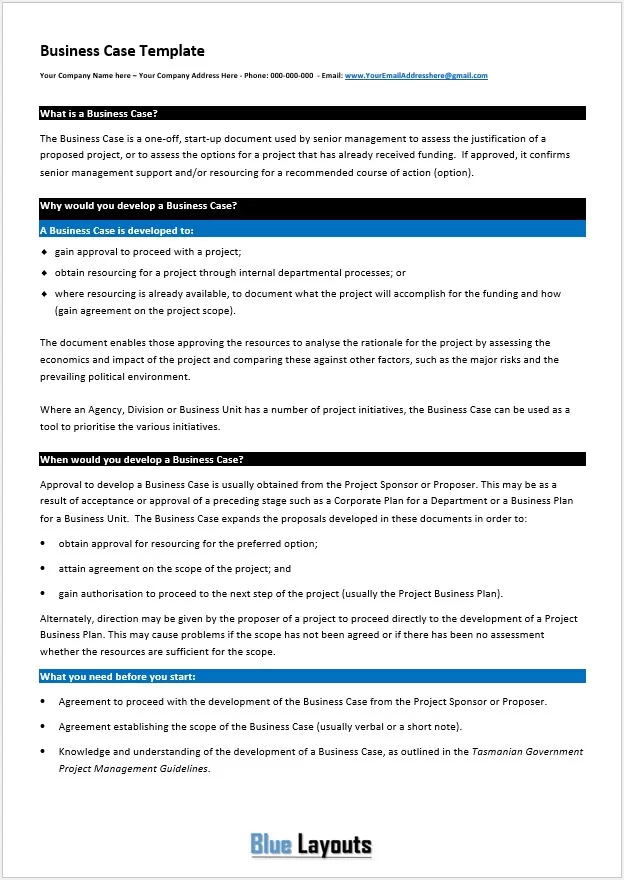
01. Detailed Business Case with Drafting Guidance
Includes extensive guidance, a document acceptance and release section, background, objectives, problem assessment, assumptions and constraints.
Best use and editing note: A structured project justification. Adapt the Tasmanian Government references and organizational process instructions. Review the source acknowledgement instruction before reusing the material.
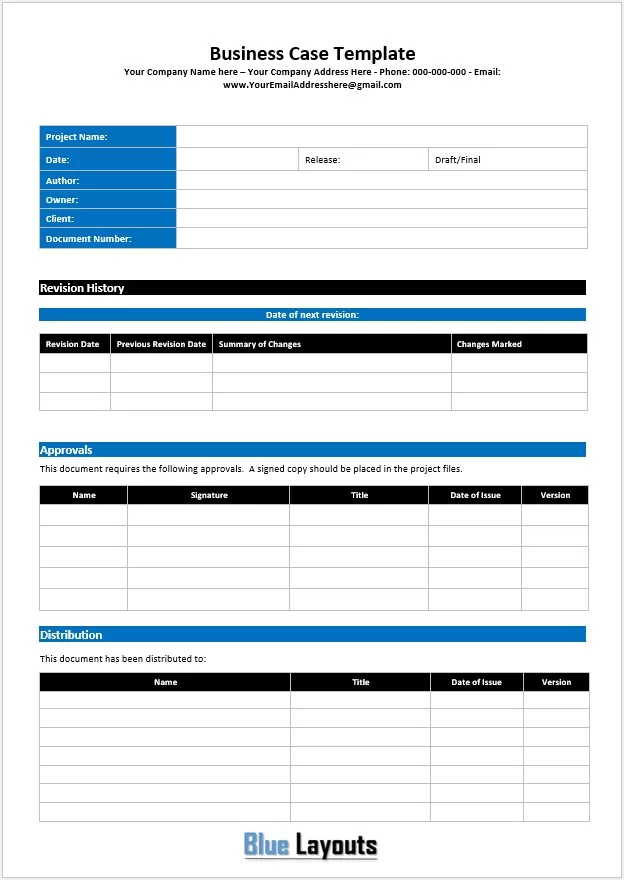
02. Business Case with Options and Investment Appraisal
Includes document control, approvals, executive summary, reasons, options, expected benefits and disbenefits, timescales, costs, investment appraisal and major risks.
Best use and editing note: A fuller decision document that will be reviewed as a project evolves. Adapt the project-methodology terminology and define how benefits will be measured.
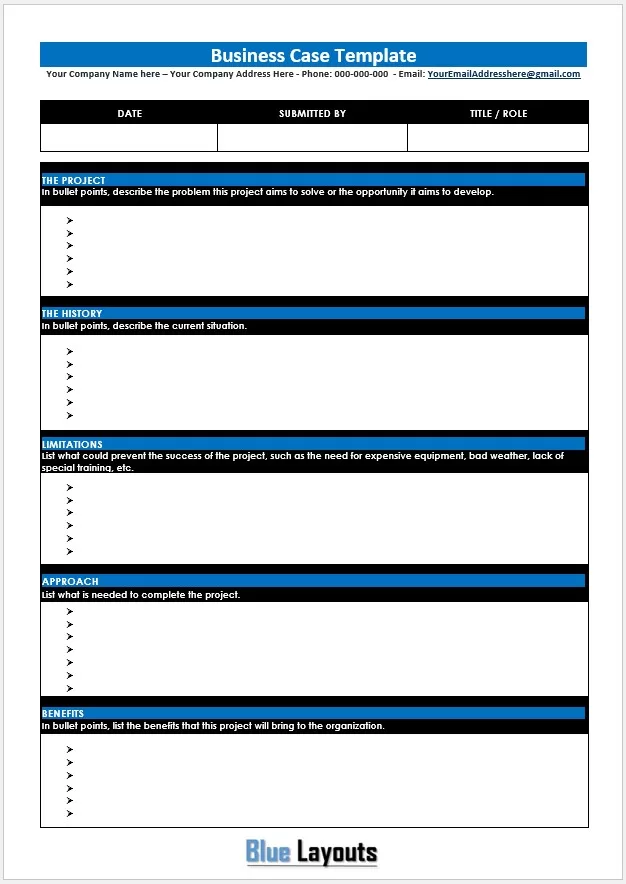
A concise form with submission details and sections for the project, history, limitations, approach and benefits.
Best use and editing note: An early discussion or small proposal. Add options, costs, evidence and a decision request before treating it as a complete approval case.
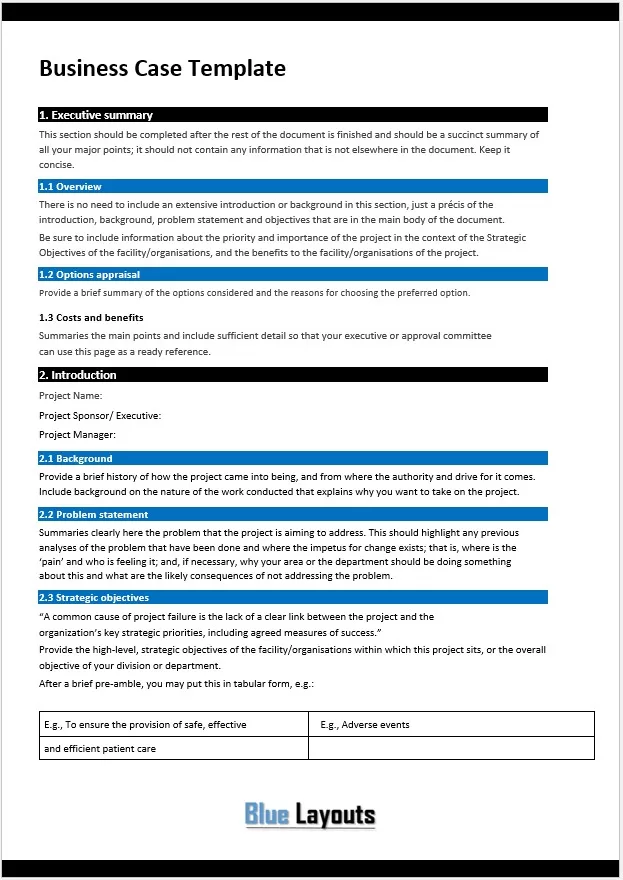
Best use and editing note: A detailed structure for an initiative with implementation considerations. Replace patient-care and infection-prevention references and check any external guidance before relying on it.
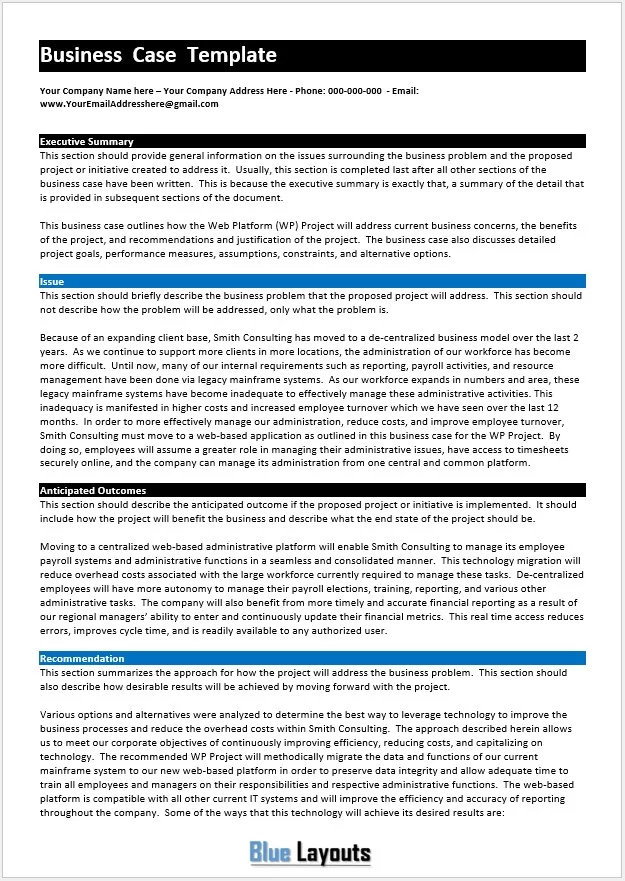
Combines instructions with a Smith Consulting web-platform example, including the business issue, anticipated outcomes, recommendation, justification and analysis-team material.
Best use and editing note: Learning how a narrative case is assembled. The example percentages and benefits are illustrative claims, not benchmarks or evidence for your project.
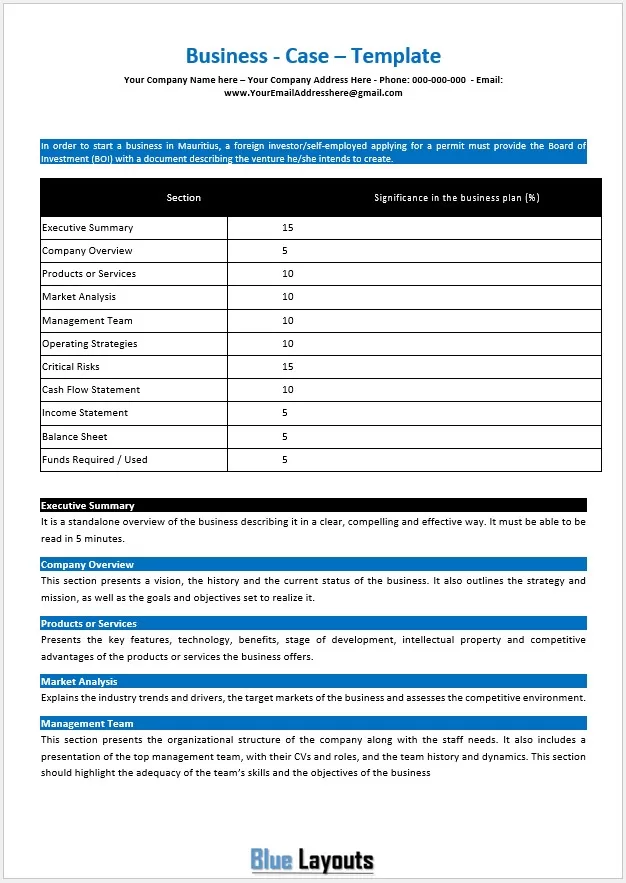
Outlines a venture’s executive summary, company, products or services, market, team, operations, risks, financial statements and funding.
Best use and editing note: Planning a business venture rather than selecting an internal project option. It contains older Mauritius BOI/permit wording and prescribed section weights; it is not verified as a current permit application guide.
A business case explains the rationale for an investment or change. It identifies the need, compares realistic options and sets out the likely costs, benefits, risks and delivery implications. Its purpose is to support an informed decision, which may be to proceed, revise the proposal, run a pilot or stop.
It is not limited to launching a company. You might prepare one for new equipment, a process change, an additional service or a replacement system. The detail should be proportionate to the decision’s scale and uncertainty.
Business Case vs. Business Plan and Requirements Document
Choose the document for the question you need to answer
Document
Main question
Business case
Why pursue this option, and is it justified compared with alternatives?
Business plan
How will the business operate, serve its market and sustain itself?
Business requirements document
What business needs and outcomes must the proposed change address?
Project plan
How will the approved work be delivered, by whom and when?
These documents can inform each other without repeating all the same material. Use a business requirements document template when you need to develop the required outcomes and scope in more detail.
How to Write a Business Case
Define the decision. State what approval, funding or next step you are asking for and who will decide.
Describe the current problem. Show the baseline with relevant evidence, such as delays, recurring costs, service gaps or missed opportunities. Distinguish measured facts from estimates.
Set measurable objectives. Explain the intended improvement, how it will be measured and by when.
Compare alternatives. Include the current approach and credible smaller changes where relevant. Apply consistent criteria and a common comparison period.
Estimate full costs and benefits. Include setup, training, transition, recurring support and other relevant costs. Record sources, assumptions and uncertainty.
Assess risks and feasibility. Explain dependencies, capacity, procurement and implementation constraints, and who will manage them.
Recommend an option. Explain why it offers the best overall fit, including tradeoffs and conditions that must be met.
Write the executive summary last. Summarize the decision, evidence, costs, expected value and principal risks without introducing new claims.
A cost benefit analysis template can support the financial comparison. Keep nonfinancial benefits visible, and avoid counting the same benefit twice under different labels.
Simple Business Case Example: A Limited Pilot
The following fictional example illustrates the reasoning, not a completed investment appraisal.
Problem: A team spends an estimated 20 hours per month re-entering requests, based on a four-week activity sample. Objective: Reduce duplicate entry while maintaining the agreed review and access controls. Options: Continue the current process, standardize the existing form, or test a request system with a small user group. Proposed pilot: $2,000 setup plus three months of subscriptions at $100 per month. Potential benefit: The pilot may release 12 staff hours per month. At an assumed $25 hourly value, that is $300 per month of productive capacity, not necessarily cash payroll savings. Main uncertainty: Whether users adopt the new process and whether the estimated time reduction is sustained. Decision requested: Approve a $2,300 pilot budget, assign an owner and review measured results before considering wider rollout.
The three-month capacity value would be 12 × $25 × 3 = $900, compared with the stated $2,300 pilot cost. That does not establish a positive short-term financial return. The case would need to explain the value of learning, any additional evidenced benefits and the basis for a later rollout decision. Do not present a favorable recommendation by hiding the cost of the pilot.
Make Costs, Benefits and Assumptions Traceable
Record where each important estimate came from: a dated supplier quote, an activity sample, an internal cost record or an explicitly stated assumption. Use the same period and currency across options, and test how the conclusion changes if costs rise, benefits fall or implementation is delayed.
For a product-and-labor estimate, a project cost summary can help organize inputs. It does not replace a full financial comparison. Multi-year proposals may need a separate appraisal that accounts for the timing of costs and benefits.
Assign an owner to each major benefit and define a baseline, target, measurement source and review date. Time released, cash savings, revenue and profit are different measures; label them accurately.
Keep the Business Case Under Review
A business case should remain connected to the decision it supports. If scope, costs, timescales or expected benefits change materially, reassess the recommendation rather than treating the original approval as permanent justification.
After work begins, use a project status report to summarize progress and emerging concerns. The status report explains current delivery; the business case explains whether continuing the investment remains justified.
Before You Share the Word Document
Replace sample organization names, numbers and project examples.
Remove author instructions while retaining any required acknowledgements.
Label assumptions and attach or link supporting evidence.
Check that the executive summary agrees with the detailed analysis.
State the decision requested, decision maker and proposed conditions.
Update document control, tables of contents, numbering and cross-references.
Review the layout and any exported PDF before distribution.
Frequently Asked Questions
Which template is best for a short business case?
Template 03 is the shortest outline. It can support an initial discussion, but you should add the options, cost comparison, evidence and decision request needed by the reviewer.
Are all six files business case templates?
The collection includes several business case structures and examples. Template 06 is closer to a venture business-plan outline and contains older location-specific permit references.
Do the downloads include Excel calculators?
No. The six verified downloads contain Word (.docx) documents. Prepare and check detailed calculations separately, then transfer the relevant results into your case.
Does every business case need market research?
Include market evidence when demand, customers or competition affect the decision. An internal process improvement may instead need evidence about workload, service quality, cost or operational risk.
Does a positive financial estimate guarantee approval?
No. Reviewers also need to consider evidence quality, affordability, delivery capacity, risks and strategic fit. Explain material uncertainty and the consequences of each option.


Pingback: Free Business Requirements Document Templates - Blue Layouts
Pingback: 6 Free Project Proposal Templates for Word