Explore nine classroom management plan templates and examples for organizing expectations, routines, positive support, and classroom review. The Word downloads include planning forms, completed examples, a self-assessment, an observation record, and a preventive-practices guide.
Choose a resource that fits your purpose, then adapt it to your students, grade level, subject, and school procedures. These are different resources, not nine interchangeable blank plans.
Formats: seven downloads contain .docx files; samples 02 and 07 contain older .doc files. Each download is a separate ZIP.
The original file sequence skips 08. The nine available files are preserved below under their existing numbers so previews and downloads remain matched.
Download the Templates and Examples
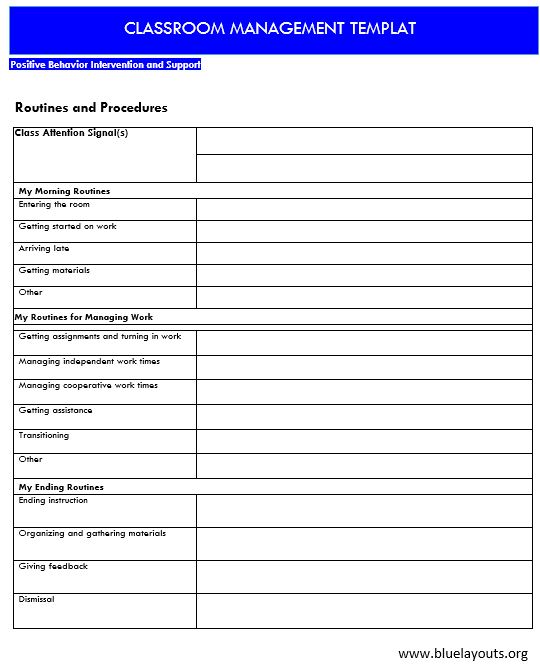
Resource 01: Routines and Positive-Support Planner
A planning form for attention signals, morning routines, work routines, dismissal, teaching expectations, and positive feedback. It also contains example behavior scenarios to review.
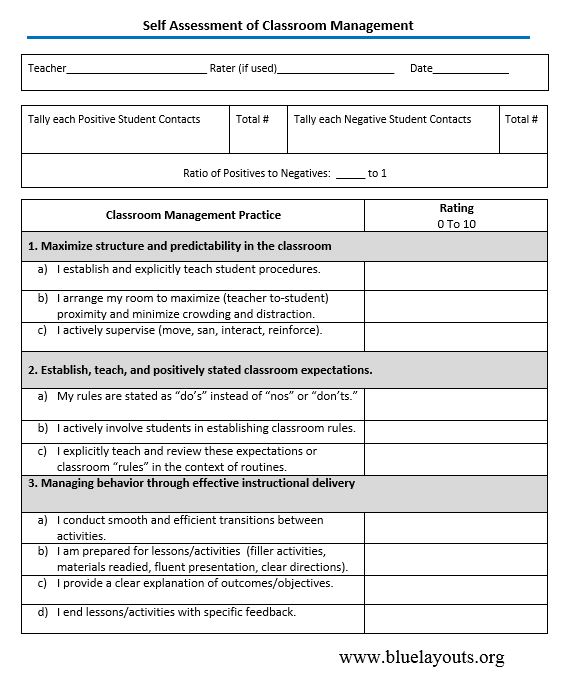
A classroom-management self-assessment and action-planning resource with a 0–3 implementation scale. It contains attribution and a May 2010 revision date; retain relevant credits and review its guidance.
A structured form for teacher and class details, expectations, attention signals, routines, student work, feedback, and encouragement. Adapt it to the approach your school actually uses.
Resource 04: Classroom Philosophy and Support Outline
A short framework for management beliefs, classroom mission or expectations, behavior supports, and positive recognition. It includes policy-reference fields.
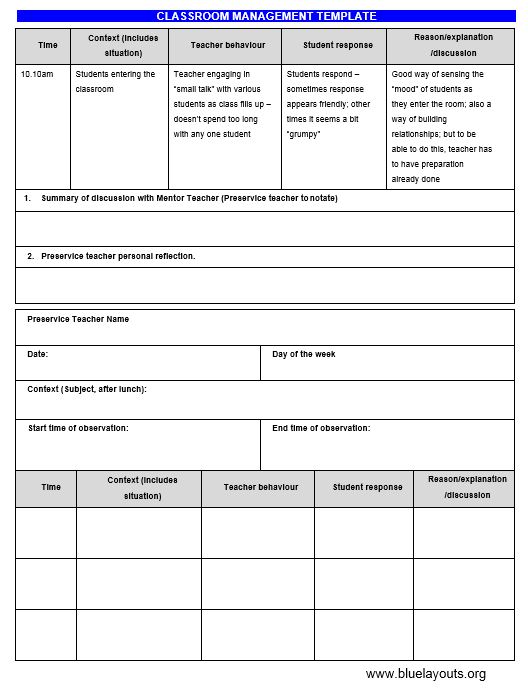
A teacher-observation table with time, context, teacher behavior, student response, and discussion columns, plus mentor discussion and personal reflection sections. This is not a complete classroom plan.
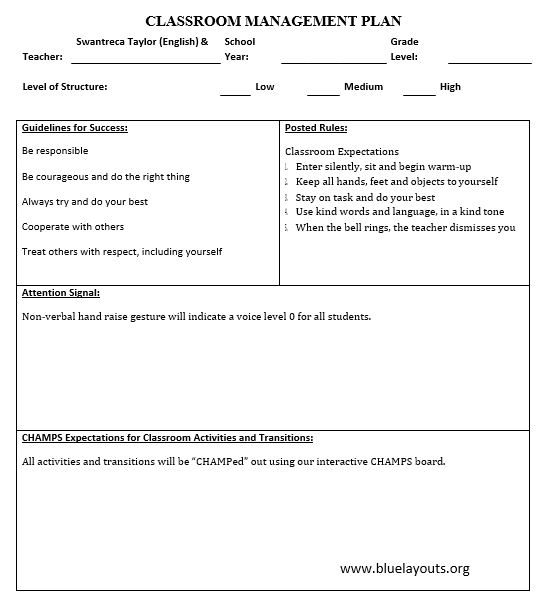
A sample with a named teacher, expectations, attention signal, encouragement, and correction procedures. Replace personal details and review every consequence against the approved school approach.
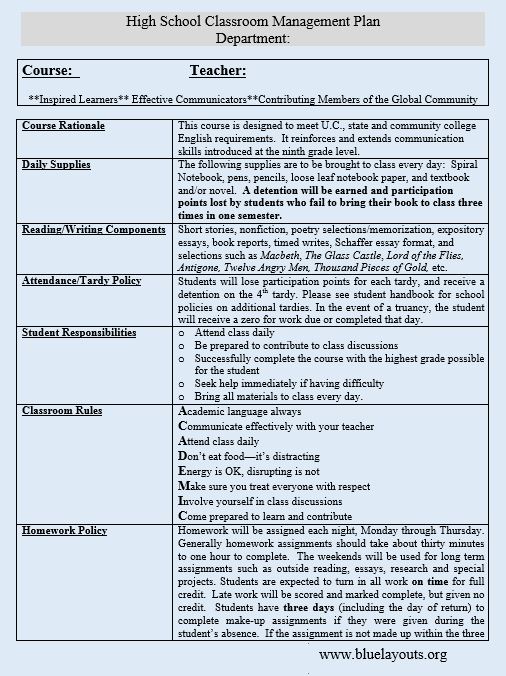
A course-specific example covering supplies, attendance, responsibilities, and classroom rules. Contains sample grading and detention provisions that should not be copied as general policy.
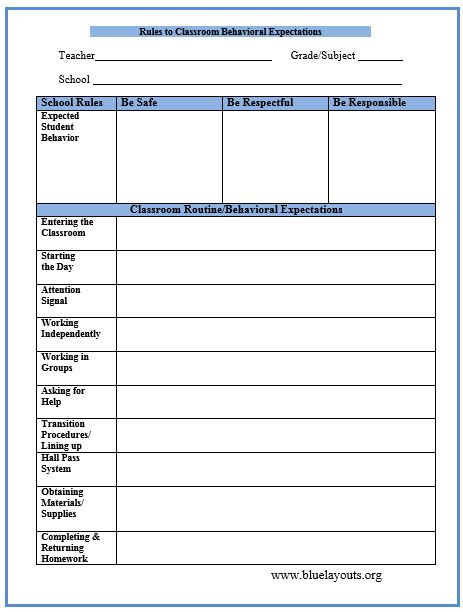
A matrix connecting school-wide expectations to routines such as entering, independent work, group work, help requests, and transitions. Includes examples to adapt.
A reference resource titled Preventive Classroom Behavior Management Practices, marked as an August 2015 draft with named authors. It is guidance rather than a blank planning template; preserve attribution.
A classroom management plan records how the class will operate: expectations, everyday routines, ways to teach and reinforce those routines, and responses when students need support or redirection.
Make it specific enough to use. “Students will be responsible” is a broad expectation; a routine explains what students do when entering, collecting materials, requesting help, or finishing an activity.
Which Resource Should You Choose?
To write a plan: start with resources 01, 03, or 04.
To connect rules with routines: explore resource 09.
To review your practice: use the self-assessment in 02 or observation form in 05.
To examine completed wording: review examples 06 and 07 without treating their policies as universal.
To read supporting guidance: review the dated reference resource in 10.
Sections to Include in Your Own Plan
Section
What to decide
Class context
Teacher, grade or subject, year, learning setting, and relevant support arrangements
Expectations
A manageable set of clear, observable expectations
Routines
Arrival, materials, work, help requests, transitions, and dismissal
Teaching and practice
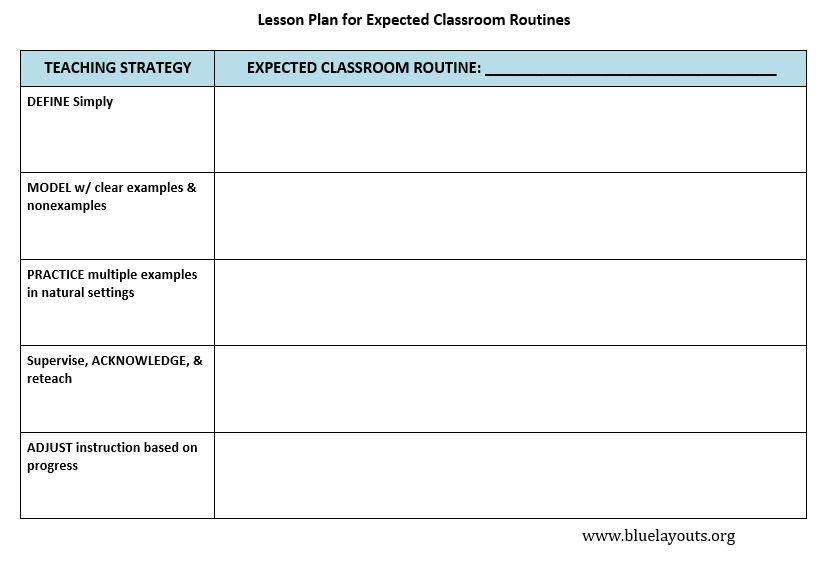
How routines will be explained, modeled, practiced, and revisited
Encouragement
How appropriate participation and effort will be acknowledged
Support and responses
Calm redirection, problem-solving, and referral routes aligned with school procedures
Communication and review
How students, families, and relevant staff receive information and how the plan is reviewed
Use the course syllabus and schedule template for separate course organization. Keep assignment information and classroom procedures consistent across documents.
How to Customize a Plan in Word
Save a working copy. Identify its class, year, owner, and review date.
Remove inherited assumptions. Replace sample teacher names, course requirements, dates, and local policy references.
Define the essential routines. Start with recurring moments that need a clear process.
Write observable steps. Describe what students and the teacher will do rather than relying on vague behavior labels.
Plan teaching and practice. Add how you will introduce the routine and check understanding.
Review access and support needs. Adapt communication, materials, and participation arrangements with the appropriate school team.
Check responses and consequences. Align them with approved school procedures and relevant individual support arrangements rather than importing penalties from a sample.
Share and revisit. Explain the plan in accessible language and revise unclear or impractical routines after review.
Example: A Help-Request Routine
Instead of “Do not interrupt,” define an appropriate way to get help during independent work:
Student routine: Use the agreed help signal and continue with another accessible part of the task while waiting, where possible. Teacher routine: Acknowledge the request and provide help or clarify what the student can do next. Practice: Model the signal and rehearse the process before independent work begins.
This is an example to adapt, not a requirement to use one signal for every learner or activity. Make alternative communication routes available where needed.
Keep Academic Assessment Distinct
Some completed examples mix classroom behavior, attendance, supplies, and grades. Review those provisions carefully before reuse. Make the purpose of each record clear and follow your school’s assessment approach.
For assessing assignment quality, use the grading rubric samples and connect criteria to the learning task rather than treating the management plan as an academic scoring rubric.
Family Communication and Acknowledgment
Explain the key routines, how families can ask questions, and which contact method the teacher uses. If your school requests acknowledgment of receipt, the parent sign-off forms offer separate layouts to review.
State what an acknowledgment means. Keep student-specific observations and support details out of a generally distributed classroom plan.
Reviewing and Printing the Document
Check every page; a preview may show only the beginning of a longer file.
Preserve author credits and check applicable usage terms for attributed resources.
Review older references and draft guidance before relying on them.
Check table widths, page breaks, and text wrapping after editing.
Keep the editable master and export a checked PDF for distribution if useful.
Frequently Asked Questions
How many downloads are available?
Nine. The existing file numbers are 01–07, 09, and 10; this page does not list a file numbered 08.
Are all the files blank classroom plans?
No. The collection also includes a self-assessment, observation form, completed examples, and a dated reference guide. Read each description before choosing.
Can I use them for different grade levels?
You can adapt relevant structures, but review language, routines, activities, and support arrangements for the actual class. Sample 07 is specifically a high-school English example.
Should I copy the sample consequences?
No. Review all sample disciplinary, attendance, and grading provisions against the approach approved for your school and students.
Do these files automatically track behavior?
No. They are Word resources, not a behavior-tracking system or automated reporting tool.
Are PDFs included?
The listed ZIP files contain Word documents. Export a PDF yourself after editing and checking the layout.