A strategic business plan connects your long-term direction with the choices, resources and measurable results needed to get there. Use these strategic business plan templates for Word to organize your priorities, assess your current position and turn selected goals into an implementation plan.
The six ZIP downloads below contain DOCX files. They include planning frameworks, departmental worksheets and guidance documents, so choose by the contents rather than the cover alone. Some files need substantial adaptation before they suit a commercial business.
Environmental scan, SWOT, positioning, measures and implementation
Adapting a detailed departmental framework
Download strategic business planning templates
Download the ZIP, extract the DOCX file and open it in Microsoft Word or compatible software. Check the document after editing because fonts, tables and page breaks can change between applications. The preview shows a sample page, not every section of the file.
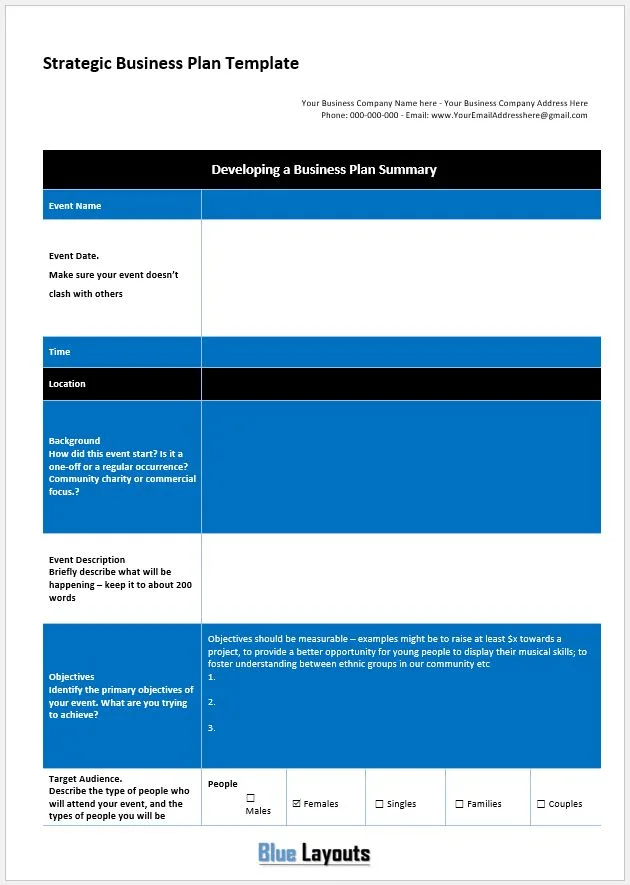
01. Event Objectives and Marketing Plan
This file focuses on an event: its background, audience, branding, promotional strategies, estimated income and expenditure, risks and evaluation. It is useful when the event itself is the project you need to plan.
Before using it: It is not a complete company strategy. Replace the sample business details and review the audience checkboxes. For a separate cost breakdown, pair it with an event budget template.
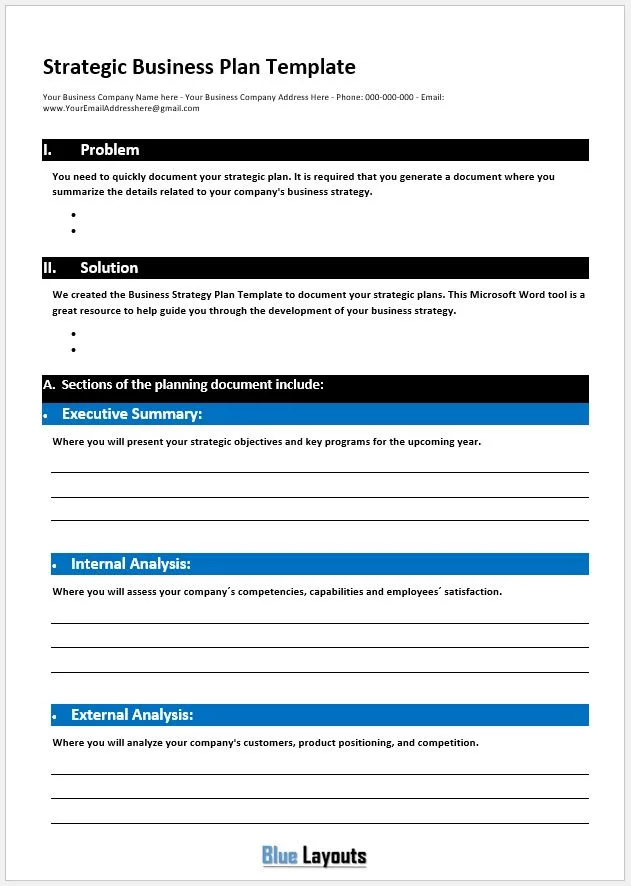
A short guidance document describes an executive summary, internal and external analysis, strategic objectives and KPIs, and goals, measures, targets and initiatives. Use those headings to build a strategy document of your own.
Before using it: The text describes tools such as a balanced scorecard and deployment schedule; it does not provide a completed set of those tools. Add your own working sections, evidence and tables.
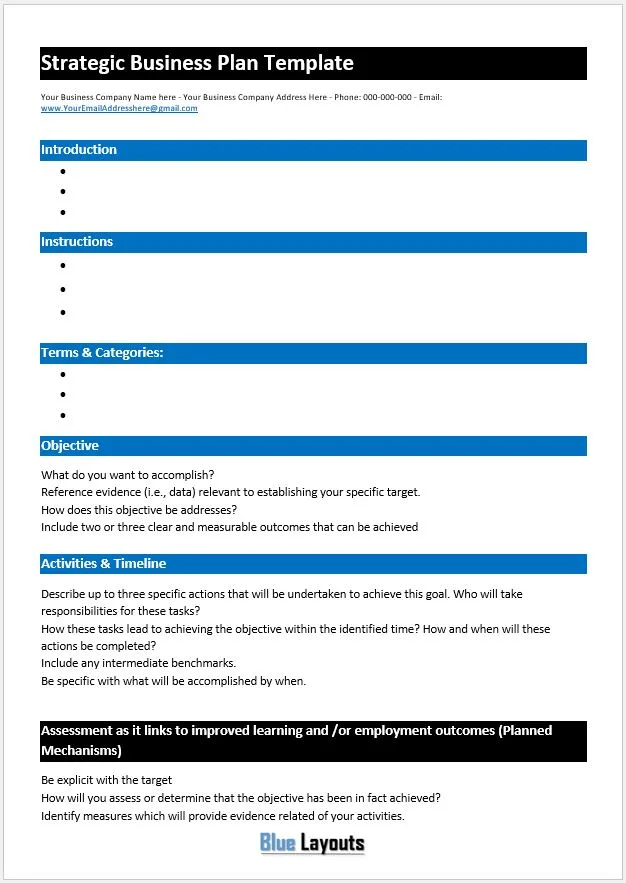
03. Departmental Goals and Implementation Worksheet
This worksheet links objectives to activities and timelines, assessment methods, resource requests and involvement from other departments. It includes instructions and repeated target tables for a department or unit.
Before using it: Several prompts refer to learning or employment outcomes and internal budget approvals. Adapt those terms to your business, and name an accountable owner for each objective.
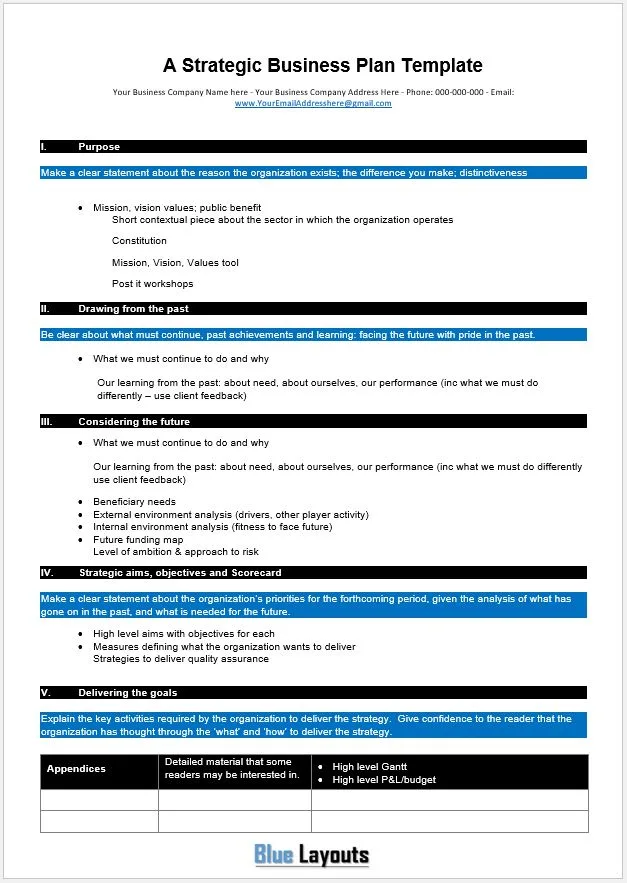
The framework starts with purpose, mission, vision and values, then considers past performance, future needs, the operating environment, funding, strategic aims and delivery. It also includes prompts for goals, objectives, strategies and enabling themes.
Before using it: The beneficiary and public-benefit language may suit a nonprofit or community organization. Commercial teams should adapt these prompts to customers, markets and business outcomes. Budget and Gantt references are planning prompts, not an automated forecast.
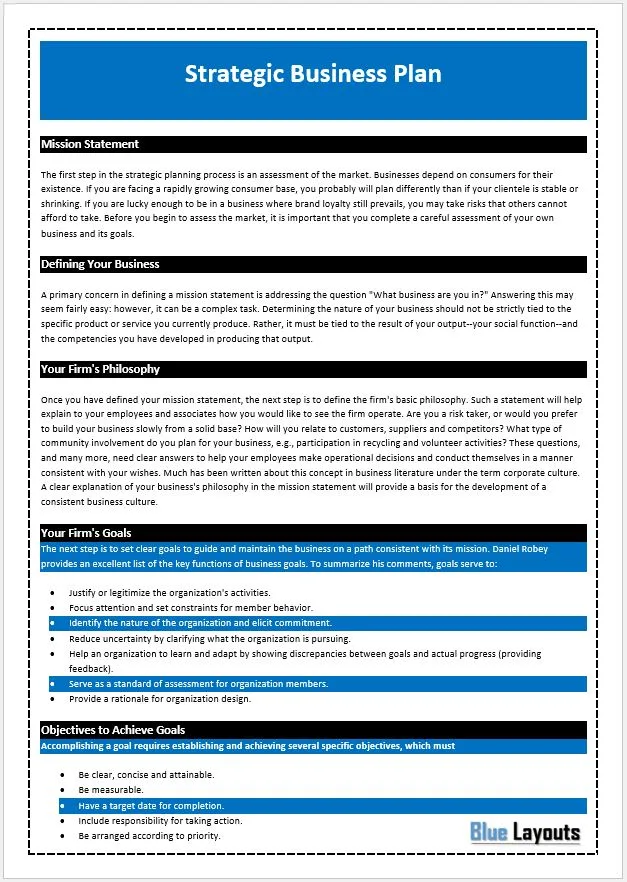
This file explains how to define a business, clarify its philosophy, set goals and measurable objectives, assess the external environment and examine internal strengths and weaknesses. It is primarily reading material to support your planning process.
Before using it: It is not a ready-to-fill strategic plan. Replace dated examples with current evidence, and create your own objective, budget and implementation tables.
This document includes vision, mission and values, environmental trends, competitor comparisons, SWOT analysis, positioning, goals and measures, strategy champions, and tasks with owners and due dates.
Before using it: It contains Regent University-specific mission, values and governance references. Replace these throughout before reuse. Its financial forecast is described as a separate template; do not assume that forecast is included in this download.
A useful plan explains where you will compete, why your approach should work and how you will know whether it is working. Include the following sections, even if you need to add them to your chosen file.
Direction and scope: Define your purpose, customers, planning period and desired future position.
Current position: Summarize relevant customer evidence, competitor activity, financial constraints, capacity and past performance. Separate facts from assumptions.
Strategic choices: Select a manageable set of priorities. Explain what you will invest in, what you will stop doing and why.
Objectives and measures: Record each metric’s baseline, target, deadline, data source and accountable owner.
Initiatives and resources: Identify the work, funding, people and dependencies required to deliver the priorities.
Risks and review: List critical assumptions, warning signs and review dates, including when you would change course.
If you also need to explain products, operations, market demand and funding to a reader unfamiliar with the company, use a small business plan template alongside your strategy. A strategic plan can complement that broader document.
Strategic business plan example: improve repeat business
This fictional example shows how to connect a strategic choice to measurable delivery. The figures are illustrative targets, not predicted results.
Planning element
Example entry
Strategic priority
Build repeat business from existing customers before expanding into a second location.
Evidence and baseline
Last year’s records show that 80 of 400 first-time customers placed a second order within 90 days: a 20% repeat-purchase rate.
Objective
Raise the 90-day repeat-purchase rate to 28% for first-time customers acquired in the first quarter. Review the completed cohort in the second quarter.
Initiatives
Improve onboarding information, test a permission-based follow-up sequence and address the most frequent service complaints.
Owner and resources
Customer service manager; an illustrative $3,000 test budget and four staff hours per week for 12 weeks.
Measurement
Customers in the cohort who buy again within 90 days ÷ all first-time customers in that cohort × 100. Use order records and exclude duplicate customer accounts.
Review and safeguards
Review implementation monthly. Evaluate the outcome only after each customer’s 90-day window closes; check margin, refunds and complaints alongside repeat purchases.
At the same cohort size of 400 customers, a 28% target would mean 112 repeat customers, compared with the baseline of 80. Those additional 32 customers would not automatically make the initiative profitable: order value, contribution margin and delivery costs still matter.
How to turn the document into a working strategy
Agree on the decision. State the main challenge the strategy must resolve, such as retention, capacity, market focus or service quality.
Gather current evidence. Use customer feedback, performance records and cost information. Date your sources and label estimates.
Compare alternatives. Consider the cost, benefits and risks of competing approaches. For a significant investment, prepare a separate business case before committing resources.
Set priorities and targets. Choose objectives that fit your capacity, and assign one accountable owner to each.
Review results and assumptions. Record progress, explain gaps and decide whether to continue, adjust or stop each initiative.
Check these details before sharing your plan
Replace sample company names, contact information, institutional wording and instructions.
Give each target a clear definition so different teams calculate it consistently.
Distinguish completed activities from achieved outcomes; launching a campaign does not prove increased retention.
Confirm that the budget and staff commitments are approved rather than merely requested.
Add a version date, plan owner and next review date, then check the exported PDF for broken tables and page breaks.
Frequently asked questions
Are these strategic business plan templates in Word or Excel?
The six downloads on this page contain Word DOCX documents inside ZIP archives. They are not Excel forecasting workbooks. Any financial analysis must be added or maintained separately.
Which file is the best starting point for a company strategy?
Template 04 offers an organization-wide planning framework. Template 06 has more detailed unit analysis and implementation prompts but needs extensive removal of university-specific content. Template 03 is useful for departmental objectives. Choose according to the sections you need rather than assuming every file is a complete business strategy.
How is a strategic plan different from an action plan?
A strategic plan establishes direction, priorities and intended outcomes. An action plan assigns the tasks, owners and deadlines needed to implement those choices. Link the two so teams can see which strategic objective each task supports.
Should a strategic business plan cover one year or several years?
Choose a horizon that fits your business and the reliability of your assumptions. You can set a multi-year direction while planning the next year’s initiatives in greater detail. Give uncertain later-year figures explicit assumptions and update the plan when evidence changes.
How often should we update the plan?
Set review dates when you approve it. Review delivery regularly and reassess strategic assumptions when demand, costs, capacity or competitive conditions materially change. Keep a record of revised targets and the reasons for changing them.