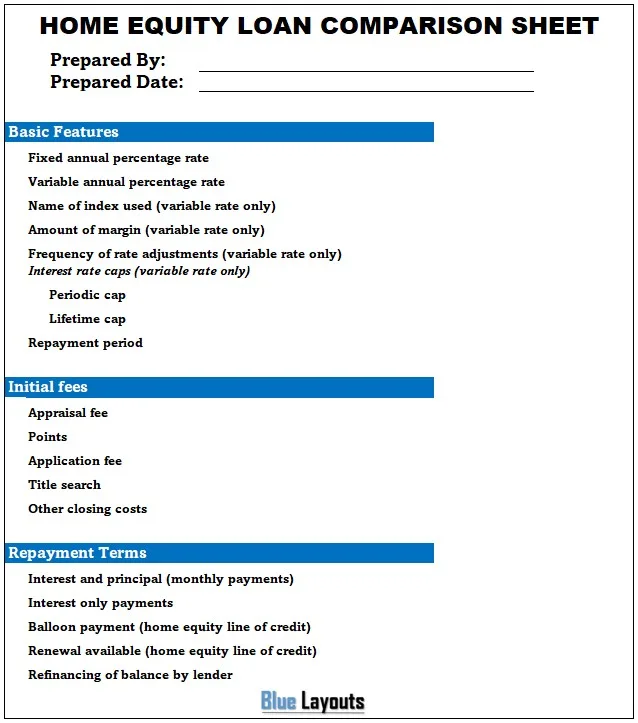
Organize lender quotes with this home equity loan comparison sheet for Excel. Record fixed or variable rates, upfront fees and repayment features so you can review offers on a consistent basis.
The download is a manual comparison checklist, not a loan calculator. It contains no formulas, payment schedule, borrowing-limit calculation or automatic lender ranking. Several rows refer specifically to home equity lines of credit, so identify whether each quote is a lump-sum loan or a HELOC before comparing it.
Download the Home Equity Loan Comparison Excel Sheet
Format: ZIP containing one Excel XLSX workbook. It includes a visible Template sheet, a hidden configuration sheet, preparation fields and sections for basic features, initial fees and repayment terms.
Extract the ZIP, open the workbook in Excel and save a working copy. Add lender names, quote dates and offer references to the entry areas or clearly labeled copies. A separate Word or PDF version is not included.
Home equity loan and HELOC: identify the product
A home equity loan provides a lump sum secured by your home. A HELOC is a revolving credit line that permits draws under its terms. Their payment structures and rate arrangements can differ. The CFPB’s loan-versus-HELOC explanation describes that distinction.
Home equity is not automatically the amount a lender will let you borrow. Approval, property valuation, existing secured debt and lender criteria affect availability. Both products use the home as collateral; inability to repay can put it at risk.
What does the comparison sheet include?
Section
Original fields
What to clarify
Basic features
Fixed APR, variable APR, index, margin, adjustment frequency, periodic/lifetime caps and repayment period
Identify the product, quote date, introductory terms and how rates can change.
Initial fees
Appraisal, points, application, title search and other closing costs
Record actual amounts and whether they are paid upfront or financed.
Repayment terms
Principal-and-interest, interest-only, balloon, renewal and refinancing by lender
Distinguish contractual rights from a possibility subject to future approval.
The original has no dedicated loan amount, net proceeds, HELOC draw-period length, recurring-fee schedule or total-cost calculation. Add these where needed. Mark a confirmed zero fee as zero and an unknown fee as unconfirmed rather than treating an empty cell as a free item.
How to compare home equity borrowing offers
Define the borrowing need. State the amount required, when it is needed and the intended repayment period.
Collect written quotes. Record lender, product type, date, expiration and conditions so entries remain traceable.
Separate rate terms. Record the stated interest rate and APR as disclosed. For variable products, capture index, margin, introductory period, adjustment timing and caps.
Itemize fees. Check upfront, financed, annual, transaction, cancellation and other relevant charges. Do not count a financed fee both upfront and within the loan balance.
Map repayment. Identify when principal must be repaid, whether a balloon exists and what changes after an interest-only or draw period.
Compare the same scenario. Use equivalent proceeds, draw patterns, time horizons and repayment assumptions, explaining any differences.
Review affordability separately. Check the combined housing-debt commitment and other expenses, including a higher-payment scenario where relevant.
The CFPB’s HELOC shopping booklet provides a broader comparison checklist. It is useful for identifying charges and draw-versus-repayment details missing from this simpler file. Lender disclosures remain the source for the actual offer.
Example: compare payments and fees together
This fictional example compares two fixed-rate, fully amortizing loans over the same 60-month term. Both provide the same loan principal; fees are paid separately upfront, all 60 payments are made, and no balance remains. The figures are illustrative, not current offers.
Item
Offer A
Offer B
Loan principal
20,000
20,000
Quoted monthly payment
410
420
Number of payments
60
60
Total scheduled payments
24,600
25,200
Separate upfront fees
1,000
200
Total included outlay
25,600
25,400
Offer A’s payment is 10 lower each month, but its higher upfront fees make the included full-term outlay 200 higher. This arithmetic does not calculate APR. It also does not apply unchanged to early repayment, a variable rate, financed fees or a HELOC with changing draws.
If comparing over a shorter holding period, include the remaining payoff and any relevant exit charges at the comparison date. Comparing installments alone can favor a longer loan simply because it repays principal more slowly.
Extra details to add for a HELOC
Keep the credit limit separate from the amount you expect to draw. Add planned draw dates, outstanding balances, payment rules during the draw period and the repayment schedule afterward. A large unused limit is not the same as debt already borrowed.
Record annual, draw, inactivity, early-closure and fixed-rate conversion fees where applicable. The CFPB fee guide identifies charges that can appear in HELOC terms. Confirm which apply to the specific offer.
Use an appropriately reviewed separate model for variable-rate payments and changing balances. This checklist does not simulate rate paths, payment resets, reduced access to credit or refinancing availability.
Connect the comparison with your wider plan
Use the living cost analysis worksheet to organize household income and expenses, adapting its categories and adding its required formulas. Include existing obligations as well as the proposed payment.
If considering replacement of an existing mortgage rather than additional borrowing, review the mortgage refinancing templates as separate resources. Refinancing and adding a home equity loan are different transactions and should not be treated as interchangeable scenarios.
Checks before choosing an offer
Confirm that rates, fees and payment figures come from the same dated quote.
Check whether introductory terms expire and what follows them.
Distinguish quoted APR from the rate used in a payment estimate; do not assume an APR field alone captures every cost on every product.
Record balloon obligations and avoid assuming future renewal or refinancing is guaranteed.
Keep the cash received, loan balance, fees and total payments separately labeled.
Review the complete disclosure and agreement, not just the completed spreadsheet.
Frequently asked questions
Does this sheet calculate monthly loan payments?
No. The original workbook contains no formulas. Enter lender-provided payments or results from an appropriate separately checked model.
Can it compare both home equity loans and HELOCs?
It has fields relevant to both, but comparing unlike products requires a defined borrowing and repayment scenario. Add HELOC draw and repayment details rather than comparing only headline rates.
Does home equity guarantee access to funds?
No. Equity is not a guaranteed credit limit or approval. Availability depends on the lender’s assessment and the product’s terms.
Does it calculate a maximum loan-to-value ratio?
No property-value, existing-lien or lender-limit calculation is included. Obtain the relevant eligibility information from the lender.
Is the lowest payment always the cheapest offer?
No. Term length, upfront and ongoing fees, remaining principal, rate changes and exit costs can affect the comparison. Use a common period and scope.
Can I use Google Sheets or share a PDF?
You can try importing the XLSX or exporting a checked PDF. Review headings and entry space after conversion. Importing does not create missing calculations or update lender terms.