Download these free bill receipt templates for Word to prepare an itemized record of goods, services and payments. Compare six layouts with business details, customer information and amount fields, then choose one that fits the transaction.
Check the document’s purpose before issuing it: some downloads include payment-received fields, while others are closer to invoices requesting payment. A bill total is not proof that the customer paid it. For a receipt, record the actual amount received, payment date and payment method, and show any unpaid balance separately.
Compare the six downloads · See a completed payment example · Read common questions
Bill, invoice or receipt: which document do you need?
| Document | Main purpose | Key distinction |
|---|---|---|
| Bill or invoice | States charges and requests payment. | A due date or total due does not confirm payment. |
| Payment receipt | Acknowledges a particular payment received. | Identifies the amount paid, payment date and related transaction. |
| Itemized receipt | Records payment with a breakdown of goods or services. | Keeps charges, payment and any remaining balance distinct. |
Download bill receipt templates for Word
Each ZIP contains a DOCX document. Extract the file, open it in Microsoft Word and save a working copy. Amounts must be checked manually; these downloads are not presented as verified automatic calculators. Inspect the final page after editing or exporting to PDF.
01. Itemized Bill Receipt with Tax Fields
Includes payment date, receipt number, customer and business address blocks, description, quantity, unit price, line total, subtotal, tax rate, tax and amount paid. The document contains two repeated blocks.
Before issuing: The “Total Amount Due” label is ambiguous beside “Amount Paid.” Rename it to “Invoice Total” or “Balance Remaining” according to what it represents, add the payment method and currency, and check each calculation.
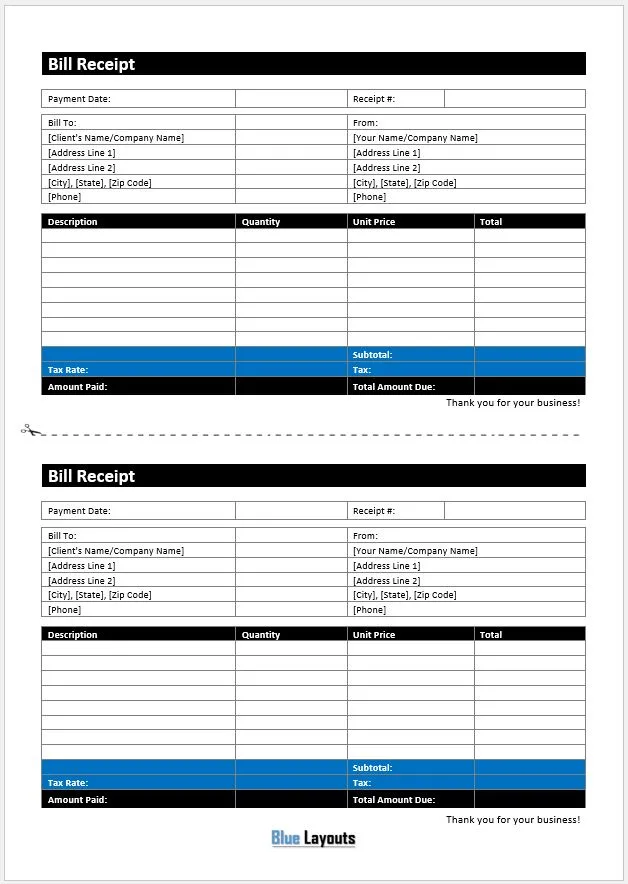
02. Simple Payment Received Receipt
Provides business contact fields, date, receipt number, item description, quantity, amount-paid entries and a total. It includes “Payment Received with Thanks” wording and two repeated blocks.
Before issuing: Add customer identification, payment method and a bill or invoice reference where needed. Clarify whether each amount is a line amount or a payment allocation. Retain the payment-received wording only when money has actually been received.
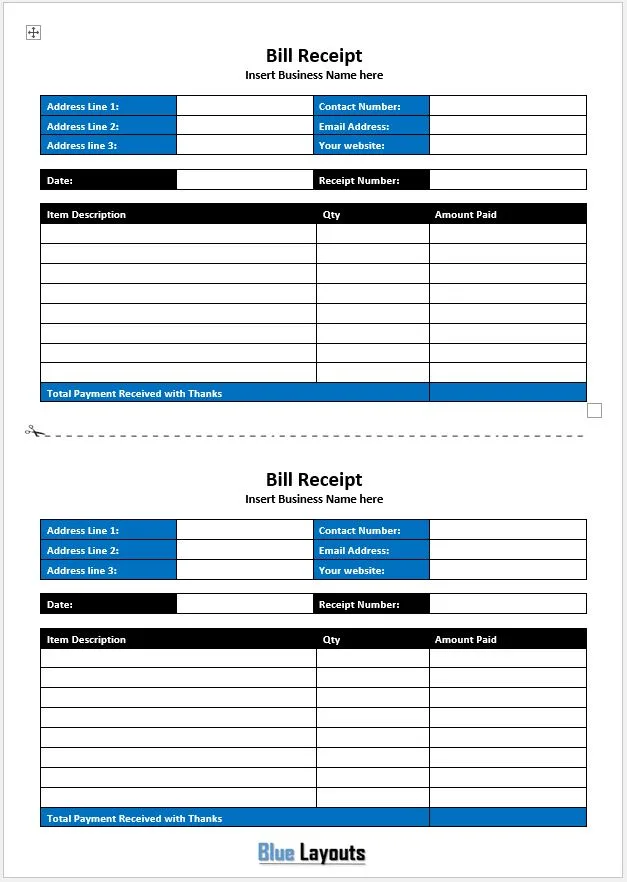
03. Bill Summary with Customer Details
Contains company and customer details, bill date, bill number, due date, description/amount rows and a total. Two repeated blocks are included.
Before issuing: As supplied, this is closer to a bill than a payment receipt: it has no dedicated amount-received, payment-date or payment-method fields. Add those fields and an accurate acknowledgment before using it as a receipt.
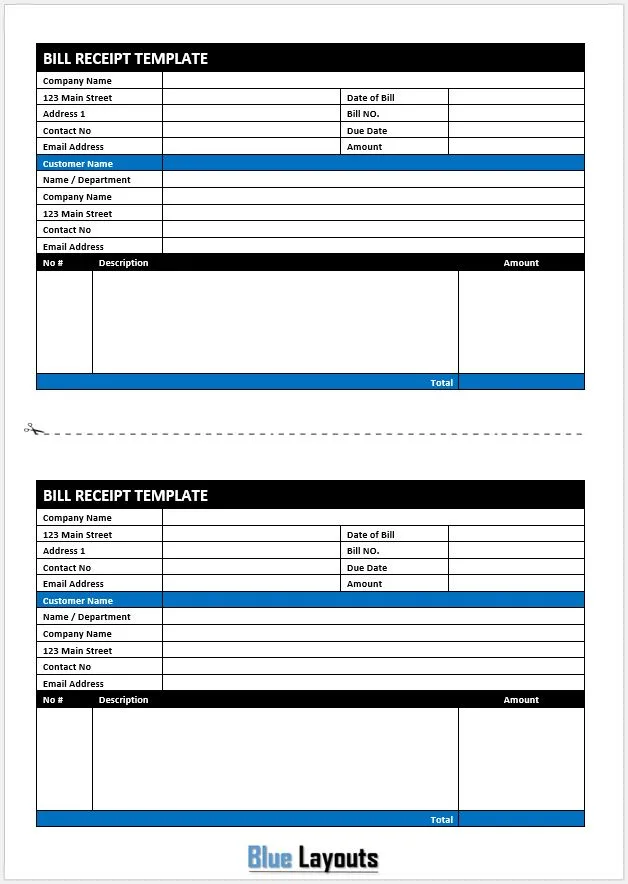
04. Detailed Receipt with Payment Method
Includes client information, checkboxes for credit card, check, cash or another method, item quantities and prices, subtotal, tax, total due, amount paid, and an authorized title/signature area.
Before issuing: Replace the sample company details. Label the date explicitly as payment date if that is its purpose, identify the related invoice and add a remaining-balance field when payment is partial. A signature alone does not confirm settlement.
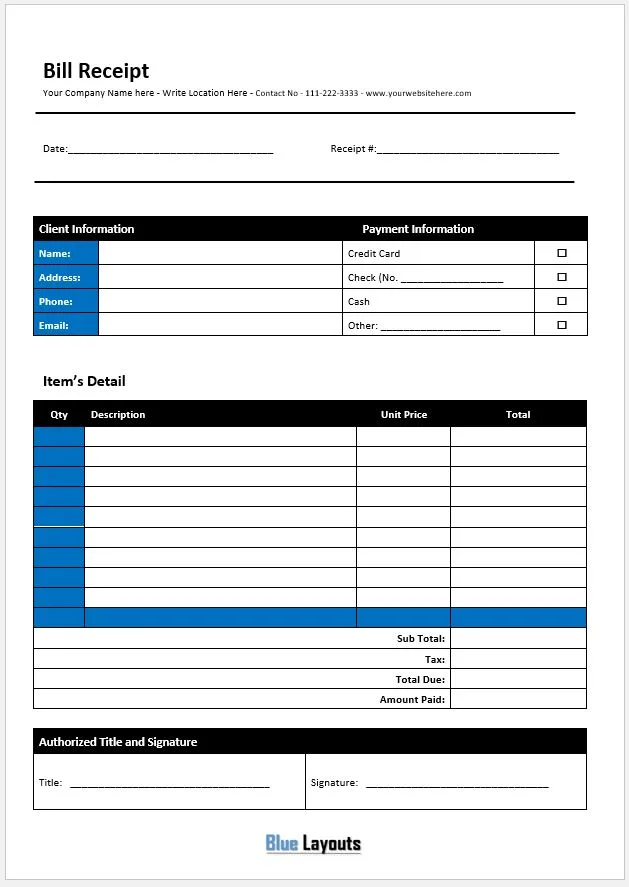
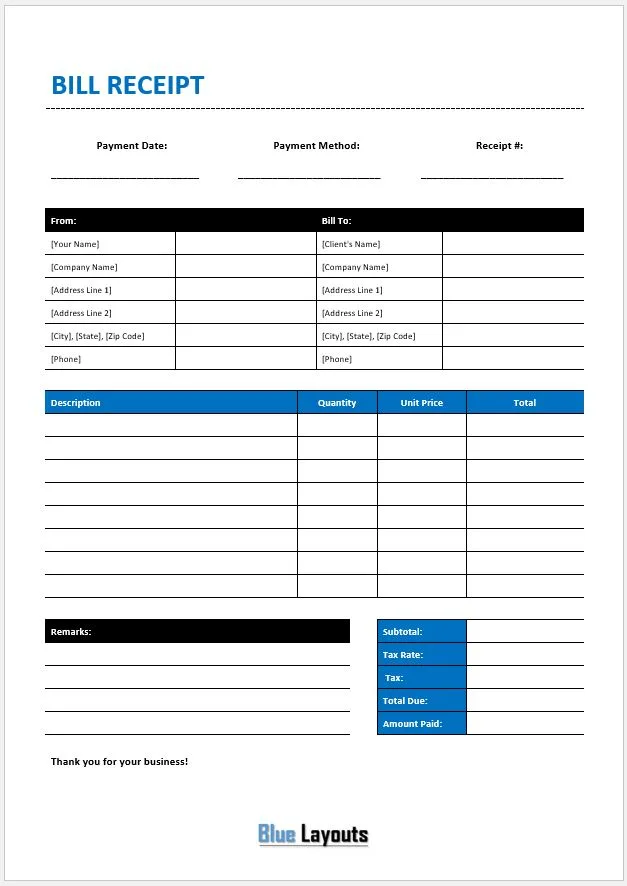
05. Itemized Receipt with Remarks
Includes payment date, method, receipt number, business and customer blocks, itemized quantities and prices, remarks, tax rate, tax, total due and amount paid.
Before issuing: Use remarks for a transaction reference or factual payment allocation. Distinguish the original invoice total from the balance after this payment, and use only the applicable tax treatment rather than copying a sample rate.
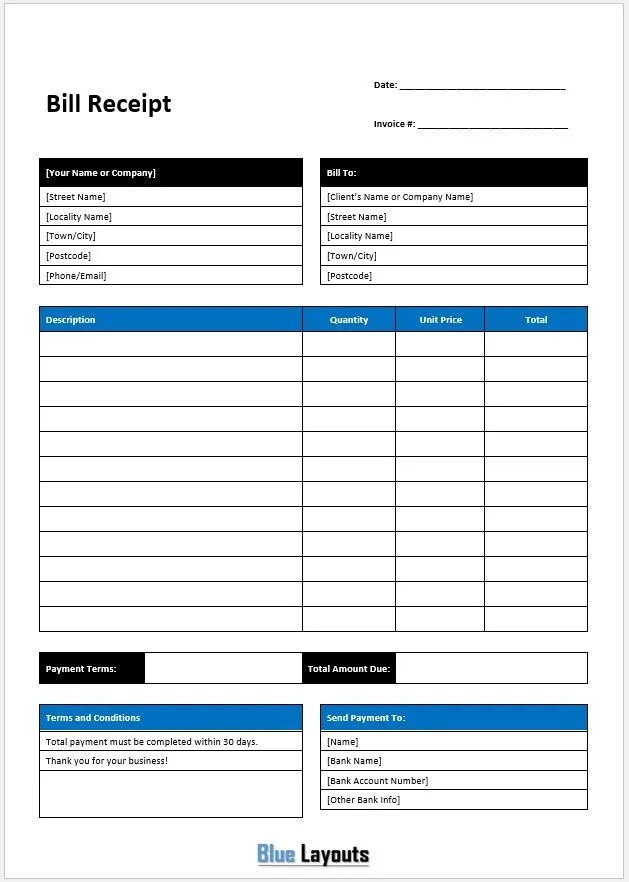
06. Invoice-Style Bill with Payment Instructions
Provides an invoice number, customer and business details, itemized charges, total due, payment terms and bank-payment instructions. It contains a sample statement requesting full payment within 30 days.
Before issuing: This file requests payment rather than acknowledging it. Use it as an invoice only after reviewing the terms, or adapt it substantially by adding payment date, amount received, method, reference and remaining balance. Remove future-payment instructions that conflict with its intended use as a receipt.
What should a bill payment receipt include?
- Business and customer: Identify who received the payment and who paid it.
- Receipt number: Give the payment record a unique reference.
- Related bill or invoice: Connect the receipt to the charges it pays.
- Payment date: Distinguish it from the invoice date and due date.
- Description: Identify the goods, services or account covered.
- Amount and currency: State the actual payment, including a clear allocation if it covers several invoices.
- Method and reference: Record cash, transfer, card, check or another method and an appropriate reference.
- Remaining balance: Show what remains for the stated invoice after prior payments and applicable adjustments.
If you extend credit, update an accounts receivable ledger as well. The receipt records one payment; the ledger helps track the customer’s charges, payments and outstanding amounts over time.
Example: a partial payment against an itemized bill
This fictional example has no tax, discounts or credits included. It shows why the bill total and current payment need separate labels.
| Field | Example entry |
|---|---|
| Receipt / invoice reference | RC-2026-018 / INV-2026-074 |
| Payment date and customer | 18 October 2026 / Example Company |
| Item 1 | Document preparation: 3 hours × USD 60 = USD 180 |
| Item 2 | Printing: 100 copies × USD 0.20 = USD 20 |
| Invoice total | USD 200 |
| Previous payments | USD 50 |
| Payment received now | USD 100 by bank transfer, reference EXAMPLE-018 |
| Remaining invoice balance | USD 50 |
The remaining balance is USD 200 − USD 50 − USD 100 = USD 50. The receipt acknowledges the current USD 100 payment. It should not describe USD 200 as received now or mark the bill paid in full.
How to complete and issue the receipt
- Choose a suitable layout. Templates 01, 02, 04 and 05 already contain payment-related wording or fields. Templates 03 and 06 need clearer payment acknowledgment if used as receipts.
- Replace all sample details. Check business names, addresses, contact information, currency symbols and repeated receipt blocks.
- Check the itemization. Verify quantity × unit price for each line, then reconcile the subtotal and any applicable adjustments. Do not assume tax fields supply a correct rate or required tax-invoice wording.
- Confirm the payment. Match it to the cash or transaction record. Describe a check or pending payment accurately rather than implying that it has cleared.
- Record the allocation. Link the payment to the correct invoice and distinguish prior payments from the amount received now.
- Share and retain a copy. Export a checked PDF if useful, keep the editable master separately and reconcile the receipt with your payment records.
Choose a receipt that fits the transaction
For a tenant’s payment, use a rent receipt template with the rental property and period clearly identified. For staff travel costs submitted for reimbursement, review the travel expense and reimbursement form; an expense claim serves a different purpose from a customer payment acknowledgment.
Frequently asked questions
Are the bill receipt templates editable?
Yes. Each download contains a Word DOCX document. You can change text and table entries. Check formatting after edits, especially if using another document application.
Is a PDF or Excel version included?
The six downloads contain Word files. You can export a completed document to PDF. They do not include a separate Excel version or a verified automatic calculation workflow.
Can I issue a receipt for a deposit or partial payment?
Yes, if that is what was received. Label the payment accurately, identify the related bill or order, and show the remaining balance where relevant. Avoid “paid in full” when a balance remains.
Can I use these for service payments?
Yes. Replace item descriptions with the service and, where relevant, the service period or completed work. For hourly services, identify hours and rate clearly rather than leaving the quantity ambiguous.
Do the tax fields make these tax invoices?
No. A tax field is only part of a layout. Required wording, registration details and tax treatment depend on the transaction and jurisdiction. These generic documents have not been verified as compliant tax invoices.
How should I correct an issued receipt?
Preserve the original record and follow your organization’s correction process. Identify any replacement or corrected version and its connection to the original receipt. Avoid silently changing amounts in a copy already given to the customer.


