Turn a development goal into a practical learning plan with these free personal development plan templates for Word. Identify a skill to improve, choose useful activities, arrange support and decide what evidence will show progress.
The collection includes six editable Word (.docx) documents, supplied in ZIP files. Some are general reflection or career-planning forms; others contain nursing, health-workforce or faculty-specific guidance. Choose the structure that fits your situation and replace inherited workplace requirements before using it.
Extract the ZIP file, open the enclosed .docx document and save a working copy. These are manually completed plans, not automatic trackers or assessments of competence.
01. Development Objectives and Learning Activities Plan
Includes guidance and a table for development objectives, priority, activities, support or resources, target dates, actual dates and review date.
Use and customization: A structured workplace learning plan. Replace university references and treat the suggested annual planning and six-month review cycle as sample guidance, not a universal requirement.
02. Nursing Personal and Professional Development Plan
A detailed nursing-oriented document with document control, institutional process guidance, SWOT and GROW discussion, responsibilities and review arrangements.
Use and customization: A specialist example rather than a generic blank plan. Review older references, hospital-specific roles and prescribed meeting or storage procedures; it is not verified as a current professional registration form.
Prompts for current strengths, development areas, feedback, performance indicators, desired capability, reasons, resources, focus priorities and a timeline.
Use and customization: Exploring where to focus before choosing actions. Convert broad reflections into observable goals and check repeated content when editing.
Organizes self-assessment, strengths, skills, values, interests, discussions with advisers, possible pathways, prerequisites, barriers and goals.
Use and customization: Comparing career directions. Adapt health-workforce terminology and verify the actual entry or qualification requirements for any pathway.
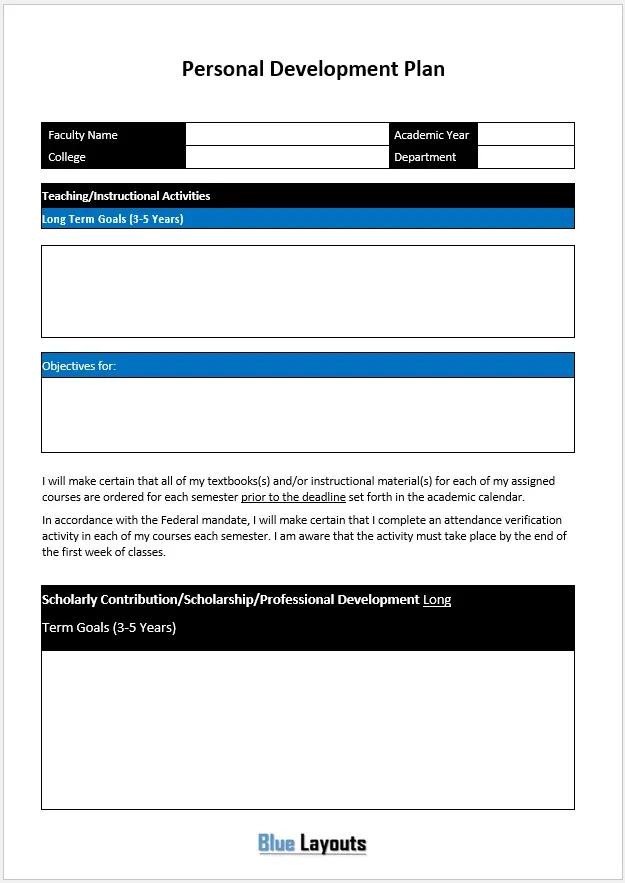
Includes faculty and academic-year details, long-term goals and objectives for teaching, scholarship or professional development, service and other duties, plus sign-off fields.
Use and customization: An academic staff plan. Replace sample textbook-ordering and attendance-verification statements with the institution’s actual expectations; do not treat its reference to a federal mandate as verified current guidance.
Includes current role, career track, strengths, development areas, issues, gaps, actions, timing and staff/manager sign-off fields.
Use and customization: A compact employee-manager discussion. Clarify “Direct Report,” add a measure of success and review date, and adapt the repeated manager signature lines to your process.
A personal development plan, or PDP, records the capabilities you want to develop and the steps you intend to take. It connects a current need or aspiration with learning activities, practical application, support and review.
It can support your current role, a future career direction or a personal learning objective. A useful plan is specific enough to guide action without becoming a long list of everything you might improve.
Which Template Should You Choose?
Start with Template 03 if you are still identifying priorities. Template 04 helps compare career pathways. Template 01 offers a structured objectives-and-actions table, while Template 06 is a compact workplace discussion form. Templates 02 and 05 are more appropriate as nursing and faculty examples, respectively, and require context-specific review.
None of the verified files is a wheel-of-life worksheet, despite the original article discussing that format. Choose according to the actual fields described above.
How to Write a Personal Development Plan
Identify a useful focus. Consider your responsibilities, aspirations, feedback and recent work. Describe the skill or capability you want to develop without making a broad judgment about yourself.
Record your starting point. Note what you can currently do and what evidence supports that assessment.
Define the intended result. State what you want to be able to do, to what standard and by when.
Choose learning and practice activities. Combine relevant instruction with opportunities to apply the skill and obtain feedback.
Arrange support. Identify the time, materials, access, budget or guidance you need. Confirm any support that depends on someone else.
Set milestones and review dates. Decide when you will check progress and what evidence you will review.
Reflect and adjust. Record what changed, what remains difficult and the next action. Update the plan when priorities or circumstances change.
A SMART goals template can help refine the objective. Use the framework as a clarity check: specific, measurable, achievable, relevant and time-bound. A measurable goal does not need an artificial percentage if a clear demonstration or reviewed work sample is more meaningful.
Personal Development Plan Example: Clearer Presentations
This fictional example shows how to connect a development need with actions and evidence.
Illustrative eight-week development goal
Development need
Present project updates more clearly within the allocated meeting time.
Starting point
Recent updates have exceeded ten minutes and have not consistently made the decision request clear.
Goal
By the end of week eight, deliver two five-minute updates that explain the current position, main concern and decision needed.
Activities
Review a short presentation guide, observe one effective update, prepare a simple outline and rehearse weekly.
Support
Agree practice time and ask a colleague to give feedback using the same short checklist.
Evidence
Two delivered updates within the agreed time, with reviewer feedback on clarity and an identifiable decision request.
Review
Check the first practice at week two, review progress at week four and assess the evidence at week eight.
The goal measures applied capability, not just attendance at a course. If practice reveals a different problem, revise the activities and record why rather than keeping an unhelpful action unchanged.
Keep Goals, Activities and Evidence Distinct
“Attend a spreadsheet course” is an activity. “Prepare a checked monthly summary using the required formulas” describes a capability. Completing the course may help, but the work sample and feedback provide different evidence.
Use an employee training log to record completed sessions separately. A training entry documents participation; it does not by itself prove that a development goal has been achieved.
Reserve time for practice and review in a quarterly planner. Check its calendar dates before use and keep the development plan as the record of the objective, evidence and learning.
Review Progress Without Turning the Plan into a Checklist
Look at evidence: What can you now do that you could not do before?
Consider application: Have you used the skill in a relevant situation?
Review support: Was the agreed time, access or feedback available?
Explain barriers: Distinguish a lack of practice opportunity from a skill gap.
Choose the next step: Continue, adjust, complete or replace the objective with a clear reason.
A PDP can inform a workplace development discussion, but it is not automatically a formal performance improvement plan. Where an employer uses a separate performance process, follow that process and clarify the purpose of each document.
Editing and Recordkeeping Tips
Remove sample instructions, institutional names and irrelevant sections. Add success evidence, a reviewer and a review date if your chosen file lacks them. Keep the table readable rather than forcing too much text into a small cell.
Save dated revisions so you can see how the goal and actions changed. Share workplace plans with the people involved in providing support and review, using the organization’s normal arrangements for employee records. Check the final layout before printing or exporting a PDF.
Frequently Asked Questions
Are these personal development plan templates available in Excel?
The six verified downloads contain Word (.docx) documents. They do not include an Excel tracker, automatic progress calculations or reminders.
Can I use a template without a manager?
Yes. Adapt the sign-off and support fields for independent learning, a mentor or another appropriate reviewer. Keep the goal, actions, evidence and review date clear.
How many goals should I include?
Choose a manageable number that you can support with time and practice. A short plan with meaningful review is more useful than a long list of unsupported intentions.
How often should I review my PDP?
Set review dates that fit the learning activity and deadline. Do not assume a sample annual or six-month schedule is required. Review sooner if circumstances or priorities change.
Can nursing or faculty staff use these files?
Templates 02 and 05 contain relevant examples, but their organization-specific procedures and older references need review. Use your employer’s or professional body’s required process where one applies.
Are PDF copies included?
The downloads contain Word documents. Export a PDF after editing and checking the layout, and retain the editable master for later reviews.




Pingback: 6 Free Action Plan Templates for Word + Practical Example
Pingback: 3 Free SMART Goals Templates for Word + Completed Examples