Put your business idea into a practical working document with these free small business plan templates for Word. Define the customer problem, explain your offer, identify how you will reach buyers and test whether the expected sales can support your costs.
The collection contains six Word (.docx) downloads, supplied in ZIP files. They include short outlines, a broader planning structure, sales and affiliate guidance, and a completed consulting-business example. Choose by purpose rather than assuming every file is a blank full business plan.
Free Small Business Plan Templates and Examples for Word
Extract the ZIP file and save a working copy of the enclosed document. Replace sample business details, instructions, claims and figures with your own evidence. These files do not include automatic financial forecasting.
01. Sales Planning Guide
Guidance on setting sales objectives, understanding customers, evaluating sales costs and choosing sales channels.
Use and editing note: Developing the sales section of a wider plan. It is not a complete business plan; review generalized claims about channel performance against your market evidence.
A step-by-step guide discussing affiliate models, products, target customers, merchant programs and supporting accounts.
Use and editing note: Exploring an affiliate venture. Replace broad claims about quick or inexpensive income and stereotyped audience assumptions with research. Verify current program terms, platform rules and required disclosures separately.
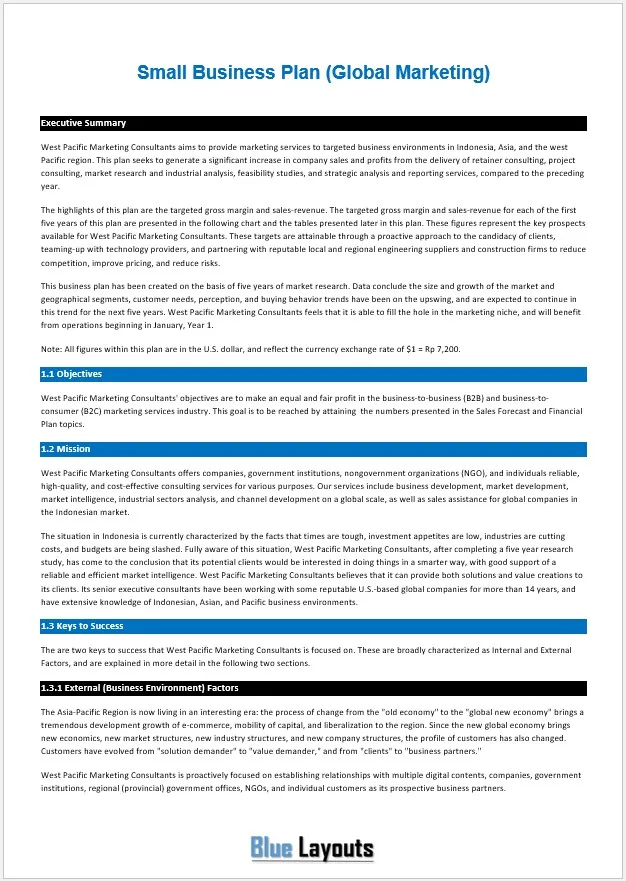
A narrative plan for West Pacific Marketing Consultants, with executive summary, objectives, mission and detailed market and operating discussion.
Use and editing note: Studying how a service-business plan is written. The sample company claims, regional market conditions, forecasts, links and exchange-rate assumption are not current evidence for your venture.
Prompts for vision, mission, timeline, strategies and funds required, described in the file as a one-page approach.
Use and editing note: An initial overview. Add explicit customer, pricing, cost and evidence detail where needed; the file’s informal pitch advice does not replace a reviewer’s requirements.
Includes executive summary, company overview, problem and solution, target market, competition, offering, marketing, milestones, metrics, forecasts and funding.
Use and editing note: The broadest general planning structure in this collection. Add operations, management and supporting financial schedules where your business or reviewer needs them.
Short-answer prompts for what the business does, delivery, customers, problem, solution, pricing, income streams, reach, referrals, competition, milestones and SWOT.
Use and editing note: Testing the core idea before writing a longer plan. Expand beyond the suggested one or two sentences when assumptions need supporting detail.
For an early idea, Template 06 can help expose gaps in your thinking. Template 04 offers a short overview, while Template 05 supports a fuller written plan. Use Templates 01 and 02 as topic-specific guidance and Template 03 as an example to study, not a ready-made statement of your business.
An internal working plan and a lender submission may need different detail. Ask the intended reviewer what information and financial schedules they require. A template does not guarantee financing or establish that an idea is viable.
The US Small Business Administration’s planning guidance provides additional context on traditional and lean formats. Use a structure that answers your audience’s questions rather than treating every heading as mandatory.
What to Include in a Small Business Plan
Business overview: What you offer, where you operate, who runs the business and its present stage.
Customer problem: The need you are addressing and evidence that customers experience it.
Offer and pricing: What the buyer receives, how you charge and why the offer is competitive.
Market and alternatives: Target segments, competitors and other ways customers solve the problem.
Marketing and sales: How prospects find you, how a sale happens and the resources required.
Operations: People, suppliers, equipment, delivery capacity and important dependencies.
Milestones and risks: What you will test, when you will review it and what could change the plan.
Funding, if needed: Amount sought, proposed sources and specific uses.
Write the executive summary after the main sections so it reflects the actual plan. Keep research sources, quote dates and major assumptions visible.
How to Build Your Plan
Define a specific customer. Replace “everyone” with a segment you can describe and reach.
Research the problem. Use relevant customer conversations, competitor observations and reliable market information. Separate evidence from guesses.
Describe the offer. Explain the outcome, scope, price and exclusions clearly.
Check delivery capacity. Estimate the time and resources needed for each order or client.
Build the numbers from assumptions. Connect sales volume to a plausible acquisition process and costs to quotes or a defined estimating basis.
Test a downside case. Consider fewer sales, slower payments or higher costs and identify what you would change.
Set the next milestones. Assign owners, dates and measures that will tell you whether to continue, adjust or stop.
Simple Service-Business Planning Example
This fictional example illustrates a few planning assumptions, not a complete forecast or recommended price.
Illustrative monthly service model
Offer
A defined monthly support package for a specific customer group.
Price
200 per client in the stated currency.
Variable delivery cost
80 per client, using a documented cost basis.
Contribution per client
200 − 80 = 120.
Monthly fixed costs
1,200, with the included costs listed separately.
Modeled break-even
1,200 ÷ 120 = 10 clients.
Capacity check
At four delivery hours per client, ten clients require 40 delivery hours, before sales, administration and other work.
The next questions are whether you can attract and retain ten suitable clients, whether the assumed costs are complete and whether payment timing creates a cash gap. Include owner compensation in the model on a clearly stated basis; do not call the result a viable personal income merely because it covers the listed overhead.
Keep Financial Estimates and Business Evidence Connected
Revenue is not profit, and profit is not the same as available cash. Explain how quantities, prices, costs and payment dates produce your projections. Distinguish confirmed orders from prospects and owner funding from customer receipts.
A growth percentage copied from a sample is not evidence of demand. Record what would need to happen to reach the forecast: prospects contacted, conversion assumptions, repeat purchases and the capacity to deliver. Review those assumptions against actual results as the business develops.
Business Plan or Business Case?
A business plan describes how the venture will operate and sustain itself. A business case evaluates a particular investment or change against alternatives. Use the latter when the immediate question is whether to buy equipment, launch a service or replace a process, while keeping it connected to the wider plan.
Before Sharing Your Word Document
Remove sample company names, outdated figures and irrelevant instructions.
Check that the narrative, sales assumptions and financial schedules agree.
Label research sources, estimates and unresolved questions.
State the version, date and purpose of the document.
Update headings, tables, page numbers and any contents fields.
Inspect the printed or PDF version and retain an editable master.
Frequently Asked Questions
Which template is best for a fuller small business plan?
Template 05 has the broadest general structure here. Add the operations, management, evidence and financial detail needed for your business and intended reviewer.
Is there a short or one-page option?
Template 04 describes a short one-page approach, and Template 06 uses concise prompts. The finished page count depends on your content and formatting.
Do these downloads include Excel forecasts?
No. The six verified downloads contain Word (.docx) documents. Prepare and check financial calculations separately and transfer the relevant results into your plan.
Can I use the consulting sample unchanged?
No. Template 03 contains a particular company narrative, market claims and old assumptions. Use it to understand structure, then write your own plan from current evidence.
Can I use a template for a loan application?
It can help organize a draft, but check the lender’s required format, schedules and supporting documents. These files are not verified loan-approval forms.
How often should I update the plan?
Set a review schedule and update it when evidence, costs, capacity or priorities materially change. Preserve earlier assumptions so you can explain what changed and why.